Thursday, November 13, 2008

"Ode to the Moon"


Ode to the Moon

by Tabish Khair

A stab of Moon
between two trees

fireflies impersonating
stars

light
tangled in the branches of the night

on the road to the riverside
where did aloneness end
and loneliness begin
How lovely when a piece of poetry surprises us by appearing in a place where we wouldn't expect to find it. This poem was "on the menu", so to speak at Ketut Suardana and Janet de Deefe's Casa Luna restaurant in Ubud, Bali. Janet as many as you will know is also the director of the Ubud Writer's and Readers Festival, so it shouldn't come as a surprise that she tries to slip a little poetry into her customers' lives. (Poetry lovers who are also foodies can slip over here to try out one of her delicious recipes.) The poem above is by Tabish Khair, an Indian poet who now lives in Denmark. I found it particularly magical, reading it on a beautiful Bali night, looking out onto the landcape of hills and trees. For all that the poem evokes a night landcape of great beauty, there is a mood of melancholy. The poem reminds me, in terms of its structure, though not its form, of the Malay pantun, with references first of all to the natural world, followed by a more personal reflection in the final two lines. Word choices surprise - "a stab of moon" - describes perhaps a very new moon, scarcely giving any light. The word stab also has an edge of violence to it, and perhaps this idea of struggle is reflected too in the beautiful image of light being "tangled" in the trees. The whole poem turns at the end with the contrast between aloneness and loneliness. Aloneness is (to some of us at least, myself included!) a good thing. We find peace and perhaps our inspiration in solitude. Loneliness on the other hand is painful. We don't want to be alone. The speaker in the poem is probably taking a night walk by the river, at first content with his own company but later realising that he is missing the company of others (or perhaps aching for that one very special person). I am touched by the simplicity of this poem. It's almost a Chinese brush painting. It feels like a haiku. A tiny true moment in someone's life that we all instinctively understand from our own. (My apologies for not being on this blog for a very long time - I've been a disorganised and dissipated blob and have to discipline myself to keep even my own blog afloat. Still I will be back and posting some reviews of poetry books that have been sitting on my desk for far too long.)

Labels: , , , , , ,

Saturday, October 11, 2008

"The Mole"

Here is yet one
more life that we see only from outside
from the outside

not in itself but later
in signs of its going
a reminder
in the spring daylight

it happened when we were not noticing
and so close to us
that we might not have been here
disregarded as we were

see where we have walked
the earth has risen again
out of its darkness
where it has been recognized
without being seen
known by touch
of the blind velvet fingers
the wise nails
descendants of roots and water

we have seen them
only in death and in pictures
opened from darkness afterward

but here the earth
has been touched and raised
eye has not seen it come
ear has not heard
the famous fur
the moment that finds its way
in the dark without us


by W.S.Merwin
From The Shadow of Sirius
------------------------------------------------------------------

After Leon’s topical post in memory of the passing of Paul Newman, mine comes oddly off timing, somewhat late, but the reasons of it being late, I will let you discover in this poem on your own. :)

“The Mole”, being the title of this poem, we read about how we do not actually see the mole. All we notice are the “signs” The raised soil of the earth that it has left behind, as it burrows underneath the ground, underneath our feet.

This poem, however, is more than just about the mole. Reading carefully, this poem is about “one/ more life that we see only from outside”. Although the word “one” refers to the mole, the use of enjambment or run-on line emphasizes that there is “more life” here that just the mole. Apparently, the word “one” encapsulates this ambiguity, that there is more what we “see only from outside”, the literal words of the poem.

We read that this life “happened when we were not noticing”, and that it works ever “so close to us/ that we might not have been here”. Indeed, the mole digs with its “blind velvet fingers” deep down in the “darkness” underground, close to our feet, yet disregarding that we are even there at all. We also read that “the earth has risen again/ out of its darkness”. Here, we see the ambiguity of the poem again. The earth, as raised by the mole, and the earth that “has risen”, not just out the “darkness” from underground, but out from the “darkness” to the present “spring daylight”.

Yes, this poem is also about spring, about the life of spring, which grows “when we were not noticing”. This is the beauty and craft of this poem, its ambiguity, and the suggestiveness with which it brings together the mole in its unseen ways and that of spring, as the life buried underneath the “darkness” of winter now springs out before us. It is this magic of the unseen, as well as the magic of this poem that the mole, not typically the most poetic creature one writes about, becomes enjoined with spring. Like the humble mole, the poem, quiet and unintrusive, goes about without any commas, full stops or punctuation, allowing the words to speak and come alive on their own. This absence of punctuation is also what gives the poem its ambiguity

Finally, the word “outside”, repeated twice at the beginning, both coming at the end of the lines, points out that we, as readers and as humans, stand “outside”. But, it also on this “outside” that we begin to quietly marvel at the mystery of nature, “touched” by its gentle, invisible lightness, as that of this poem.

Labels: , ,

Wednesday, September 20, 2006

"Dragonflies"


Dragonflies
By Frances Leviston

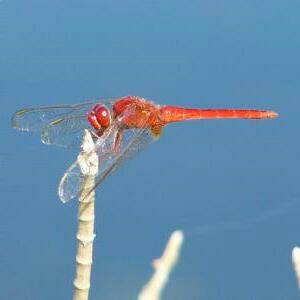
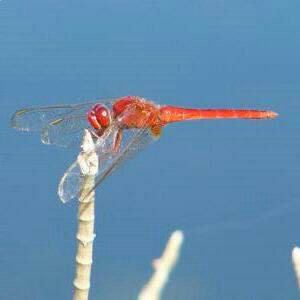
Watching these dragonflies
couple in the air, or watching them try,
the slender red wands
of their bodies tapped
end to end like fingertips, then faltering wide
on the currents of what feels to me
a fairly calm day,

I think of delicate clumsinesses
lovers who have not yet mentioned
love aloud enact,
the shy hands they extend
then retract, the luscious fumbled chase
among small matters seeming massive
as rushes are to dragonflies,

and in the accidental
buzz of a dragonfly against bare skin,
how one touch fires
one off again on furious wings
driven towards love and love, in its lightness,
driven the opposite way,

so in fact they hardly meet
but hang in the hum of their own desires.
still, who would ask
these dragonflies to land on a stone,
and like two stones, to consummate?
How can I demand love stop, and speak?


This piece appears in New Writing 14, published this year. You’d be hearing more of her if the quality of her writing is equal to what we see here in her poem Dragonflies. She has a very short collection of 12 pieces, called, appropriately, Lighter, by Mews Press, two years back, and last year she was one of the poets in another short collection, Tower Poets. So far she hasn’t yet been published by a major publishing house, until Picador, who would be publishing her first major collection soon. She’s Scottish originally, Oxford-educated, with a Writing MA from another university.

In the first stanza, we see, or rather, the writer sees, a pair of dragonflies attempting, rather futilely, to mate. They just manage to touch with their wand-like bodies, having to separate. The effect here is a little comic, when you see, next, the observer saying it’s a fairly calm day to her, at the same time when some desperate lovers are frantically trying to consummate their love.

The second stanza introduces to us the poet’s “delicate clumsinesses”, in the way she, very deftly but still outwardly a little clumsily, describes this. The two lines following are a qualification to “delicate clumsinesses”. They look a little awkward but are very complex in syntax. Still, they finally do work out. “who have not yet mentioned/love” qualifies “lovers”, inside “aloud enact”. In turn, “lovers who have not yet mentioned/love aloud enact” qualifies “clumsiness”.

She illustrates this sort of “delicate clumsinesses” with the image of, probably, human lovers reaching out to each other, like the dragonflies with their wand-like bodies. And, like the insects separating wide, these human hands are drawing back from each other. All this is some kind of fumbling love-making, just like the “rushes” of the dragonflies. Notice the “m” sounds in “Among small matters seeming massive”: this is how Leviston deftly segues from the human element to the insect one, by making us hear and feel the humming of the dragonflies.

The 3rd stanza marries the dragonfly to the human, we don’t see exactly who, by making the insect connect physically to the human by its touch. And Leviston, once more, does some clever transition to the insect element, by implying that the human touch on the insect is making it flap its wings furiously.

The last two lines in the stanza are very interesting.

driven towards love and love, in its lightness,
driven the opposite way,

The repetition of “love” is so overtly a pairing. And it is also a separation, even if the conjunction “and” should, by rights, be joining “love”. And this is confirmed by the next line. Also, repeating “driven”, both as the first word of consecutive lines gives this an urgency.

The last stanza sums everything up, about lovers - insect and human - finding it hard to consummate their love. “How can I demand love stop, and speak?” harks back to “delicate clumsinesses/lovers who have not yet mentioned/love aloud enact,”.

In sum, there are a lot of motifs about coming together and separating. As a parting shot, I’m asking you to notice the clever way in which Leviston creates a huge word-gulf between “clumsinesses” and “enact”, to emulate such a separation. She also reverses or re-arranges the syntax here so that you have to traverse over so many words in order to see, finally, it is the lovers who are enacting this delicate clumsiness. Posted by Picasa

Labels: , ,