Thursday, January 28, 2010

Not Knowing Why

Text by Leon Wing
Poem by Ann Struthers

Not Knowing Why


Adolescent white pelicans squawk, rustle, flap their wings,
lift off in a ragged spiral at imaginary danger.
What danger on this island in the middle
of Marble Lake? They’re off to feel
the lift of wind under their iridescent wings,
because they were born to fly,
because they have nothing else to do,
because wind and water are their elements,
their Bach, their Homer, Shakespeare,
and Spielberg. They wheel over the lake,
the little farms, the tourist village with their camera eyes.

In autumn something urges
them toward Texas marshes. They follow
their appetites and instincts, unlike the small beetles
creeping along geometric roads, going toward small boxes,
toward lives as narrow or as wide as the pond,
as glistening or as gray as the sky.
They do not know why. They fly, they fly.

*


Why do animals do the things they do, really?  Not being human they do not have any agenda nor reasons for their actions, do they?  Well, they just do, is all. 

And why do the movies, and movie makers like Spielberg, endow animals with human characteristics?  So that humans watching can relate or make a connection when watching them in the film?

Which is why in the first line even the poet imbues the pelicans flying off from the island in Marble Lake with human qualities, as if they are really some adolescents, like our human equivalents. But these feathered adolescents are not very graceful, at the beginning. They “squawk, rustle, flap” and then “lift off in a ragged spiral at imaginary danger”.

The balking at the end of “squawk” tells us how akward their take-off is. As they gain height, they become less so, as “rustle” tells us.  Then “flap” and “lift”, with their l sounds, tell us they’re off and flying smoothly now. Or are they, with “ragged spiral at imaginary danger”:  danger./What danger?

After this question mark, the pelicans continue their flight smoothly.  And the reader can feel this unruffleness, reading the soft and lulling r’s, f’s, l’s and w’s in “They’re off to feel/the lift of wind under their iridescent wings”.

The three “because”s bring us humans down back to earth, to realize why these pelicans fly so.  At the break, after “Spielberg”, with a full-stop, like a cut-to in a film, we see them fly, effortlessly, again, reading the repeating of the  w’s, l’s and f consonants and the long vowels in “They wheel over the lake,/the little farms”. “little” , followed, a word later, by a comma marks the sight of the tourist village from a bird’s eye view.

The second stanza explains more about why the birds fly away, even when there is no danger. The explanation: none, really; besides just hunger and animal instincts, just like the ground-moving animals. 

The last two lines are a symphony of rhymes: possible off-rhymes in "gray" and "sky"; full rhymes in "they", "they", "they", and "sky", "why", "fly", "fly".  They simulate the many birds up in the sky, flying.

They just fly, is all. 

*

This poem first appeared in the Coe Review, Vol. 39, no. 1, in 2008.


Recent work of Ann Struthers:
What You Try to Tame, The Coe Review Press, 2004


Labels: ,

Monday, October 27, 2008

"Purring" by Coleman Barks


Purring
by Coleman Barks

The internet says science is not sure
how cats purr, probably
a vibration of the whole larynx,
unlike what we do when we talk.

Less likely, a blood vessel
moving across the chest wall.

As a child I tried to make every cat I met
purr. That was one of the early miracles,
the stroking to perfection.

Here is something I have never heard:
a feline purrs in two conditions,
when deeply content and when
mortally wounded, to calm themselves,
readying for the death-opening.

The low frequency evidently helps
to strengthen bones and heal
damaged organs.

Say poetry is a human purr,
vessel mooring in the chest,
a closed-mouthed refuge, the feel
of a glide through dying.

One winter morning on a sunny chair,
inside this only body,
a far-off inboard motorboat
sings the empty room, urrrrrrrhhhh
urrrrrrrhhhhh
urrrrrrrhhhh


Coleman Barks is better known for translating Rumi’s poems without following the rhythm and rhyming of their original Persian. Instead he does something new, something unheard of, possibly deemed sacrilegious by die-hard Rumi fans: he turns them into modern free verse. Regardless of this, critics have to agree he still manages to capture the essence of Rumi’s verses.

In this piece, from a new collection of his own works, Winter Sky: New and Selected Poems, 1968–2008, published by University of Georgia, where he once taught poetry and creative writing, Barks attempts to explain to us how a cat purrs. 

Like most of us he depends on the Web for answers. Even scientists haven’t found out, assuming it’s the animal’s larynx that’s vibrating.  He underpins this using the r, p and b sounds in "purr, probably/a vibration of the whole larynx,".  When it comes down to how we humans sound he dismisses all those previous sounds: "unlike what we do when we talk."
 
Then, in the second stanza, he sums up what he thinks it is about purring, in two lines, scientifically indeed, even if he himself is not sure ("Less likely"), as “a blood vessel/moving across the chest wall.”

It appears Barks himself has been making empirical experiments to get some answers. In the third stanza you get a cutesy image of him as a little boy coming across cats and “stroking” them “to perfection”, to get the purr out of them; which is a miracle to a child.  Here, there are more "purr" alliterations in "miracles,/the stroking to perfection."

Whether the cat is happy or wounded, he still purrs. Apparently he does this to “ strengthen bones and heal/damaged organs”. Personally this writer has seen cats heal themselves by finding and ingesting certain plants, regurgitating the bolus later.

In stanza six Barks compares poetry to purring, but of a human kind. Here, he repeats "say", from the first stanza, where "The internet says", as we humans "say", not "purr", unless if it is poetry.  He gives us an image of a vessel moored in the chest. You “feel” it “glide through dying.”: poetic purring apparently heals.

In the last stanza we see what this “vessel” looks like: a motorboat. Its “purring” is so audible, humming (“sings”) in “the empty room” of “One winter morning on a sunny chair”. We have "this only body" because only cats have virtually nine.   There is such joy picked up in "inboard motorboat/sings the empty room".  This vessel doesn't merely "sings" in "the empty room".  The transitivity of the verb includes the empty room in the singing. It’s like some operatic aria, building up from a little sound, like “a blood vessel”, to an actual vessel (note the repeating of vessel as a rhyme), a motorboat.

The final lines realise this purring. Reading out loud the “urrrrrrrhhhh”s is like a chorus singing a prayer, or an incantation.

Labels: , , ,

Saturday, October 11, 2008

"The Mole"

Here is yet one
more life that we see only from outside
from the outside

not in itself but later
in signs of its going
a reminder
in the spring daylight

it happened when we were not noticing
and so close to us
that we might not have been here
disregarded as we were

see where we have walked
the earth has risen again
out of its darkness
where it has been recognized
without being seen
known by touch
of the blind velvet fingers
the wise nails
descendants of roots and water

we have seen them
only in death and in pictures
opened from darkness afterward

but here the earth
has been touched and raised
eye has not seen it come
ear has not heard
the famous fur
the moment that finds its way
in the dark without us


by W.S.Merwin
From The Shadow of Sirius
------------------------------------------------------------------

After Leon’s topical post in memory of the passing of Paul Newman, mine comes oddly off timing, somewhat late, but the reasons of it being late, I will let you discover in this poem on your own. :)

“The Mole”, being the title of this poem, we read about how we do not actually see the mole. All we notice are the “signs” The raised soil of the earth that it has left behind, as it burrows underneath the ground, underneath our feet.

This poem, however, is more than just about the mole. Reading carefully, this poem is about “one/ more life that we see only from outside”. Although the word “one” refers to the mole, the use of enjambment or run-on line emphasizes that there is “more life” here that just the mole. Apparently, the word “one” encapsulates this ambiguity, that there is more what we “see only from outside”, the literal words of the poem.

We read that this life “happened when we were not noticing”, and that it works ever “so close to us/ that we might not have been here”. Indeed, the mole digs with its “blind velvet fingers” deep down in the “darkness” underground, close to our feet, yet disregarding that we are even there at all. We also read that “the earth has risen again/ out of its darkness”. Here, we see the ambiguity of the poem again. The earth, as raised by the mole, and the earth that “has risen”, not just out the “darkness” from underground, but out from the “darkness” to the present “spring daylight”.

Yes, this poem is also about spring, about the life of spring, which grows “when we were not noticing”. This is the beauty and craft of this poem, its ambiguity, and the suggestiveness with which it brings together the mole in its unseen ways and that of spring, as the life buried underneath the “darkness” of winter now springs out before us. It is this magic of the unseen, as well as the magic of this poem that the mole, not typically the most poetic creature one writes about, becomes enjoined with spring. Like the humble mole, the poem, quiet and unintrusive, goes about without any commas, full stops or punctuation, allowing the words to speak and come alive on their own. This absence of punctuation is also what gives the poem its ambiguity

Finally, the word “outside”, repeated twice at the beginning, both coming at the end of the lines, points out that we, as readers and as humans, stand “outside”. But, it also on this “outside” that we begin to quietly marvel at the mystery of nature, “touched” by its gentle, invisible lightness, as that of this poem.

Labels: , ,

Tuesday, December 12, 2006

"Wilderness"


Wilderness by Patti Smith


Do animals make a human cry
when their loved one staggers
fowled dragged down
the blue veined river

Does the female wail
miming the wolf of suffering
do lilies trumpet the pup
plucked for skin and skein

Do animals cry like humans
as I having lost you
yowled flagged
curled in a ball

This is how
we beat the icy field
shoeless and empty handed
hardly human at all

Negotiating a wilderness
we have yet to know
this is where time stops
and we have none to go


Wilderness is quite germane to some situation I’m in at the moment. I came across this particular poem as the Saturday poem of the first week of December, in The Guardian Books section. Then, it was about a couple of weeks since I gave up my two cats, and, now, a few weeks back, another two more. Lately I have been having panic attacks thinking about their future. I’m assured of the good placements of the earlier pair, one of them a kitten only a few months old. He is having a great life, I know, because his new owner carries him around everywhere she goes. And his big brother loves to wander around the housing estate, coming back only late at night, preferring to sleep outside the house, in a cat carrier. The other two still worry me as I have no idea how they are getting on, and one of them is the mother to all the other three Toms.

So, Do animals make a human cry, when their loved one staggers/ … Does the female wail/ miming the wolf of suffering ?

You would notice that the lines in the first three stanzas are instinctively read out as questions, even though there are no question marks to indicate them as such. Actually, overall, there is not a single punctuation, of any kind: no commas to help you to pause or to demarcate syntactical groupings, no full stops to signal a sentence pause. You are only aware of the start of a new sentence by the capitalization on the first line of every stanza.

Of the absence of the question marks, the poet is telling the reader that the questions may also be assertions or statements. Yes, she could aver, animals do sometimes make cries that sound human when their young and mates are injured. In the second stanza it is not so obvious if the female here is referring to someone human. But I bet it could well be, when the next, or third, stanza, has for the first line a variation of that of the first stanza. In the third stanza the animal and human elements in pain and loss are brought together, and, closer still, those of the person of the poet or narrator.

We now know the reason she is asking (or stating) those questions. She herself has lost someone, and her pain is so very graphic in the lines with yowled flagged/curled in a ball. These lines have poignance when each verb is read out with such emphasis, without even needing any commas to separate them to slow the pace. The three words utilize the “l” sounds to draw out the reading, much like some ululation; also “ed” helps to put some virtual pauses between the words. You should note that yowled flagged echoes fowled dragged in assonance in the first stanza, also in a third line. These two groups link the pain and loss felt by animals to similar emotions in humans, particularly the poet’s personally.

In the penultimate stanza, even if we can beat the icy field (standing for pain, perhaps) by being shoeless and empty handed (like animals), the poets tells us this is not human in nature. Of mother nature, she instills some human traits, into the river with “blue veins”, and into flowers, with lilies crying out.

In the last stanza nature is invoked again, for the last time, as a wilderness, where we are still not aware of time stopping here. The way the line breaks after wilderness, without a comma we can mistake the next groupings to be describing this wilderness. But, really, reading past “know” onto the next line, we realize those groupings are not qualifying “wilderness”.

The last line, with “none”, can be taken as and there is no more to move into. Or and we have nothing to go to. However, as the preposition to is missing at the end, those interpretations are very shaky. “None” can also be a Roman Catholic service used to be read or chanted at 3pm or before. This is the ninth canonical hour beginning from sunrise. So, we can read this as this is where time stops, when we chant the none.

Again, I could be wrong, as there are no religious motifs to imply none as religious, and the main motifs are all of Nature and rather pagan.

And this is also where the poet appropriately ends her lines and does not pen more.

Note on poet: Patti Smith is famous as a punk rocker in the 70's, with her debut album "Horses". Her latest book of poems "Auguries of Innocence" is out this year from Virago of UK.

Labels: ,

Tuesday, July 18, 2006

"On the death of a Favourite Cat, Drowned in a Tub of Gold Fishes"

'Twas on a lofty vase's side,
Where China's gayest art had dyed
The azure flowers that blow,
Demurest of the tabby kind,
The pensive Selima, reclined,
Gazed on the lake below.

Her conscious tail her joy declared;
The fair round face, the snowy beard,
The velvet of her paws,
Her coat, that with the tortoise vies,
Her ears of jet, and emerald eyes,
She saw; and purred applause.

Still had she gazed; but 'midst the tide
Two angel forms were seen to glide,
The genii of the stream:
Their scaly armour's Tyrian hue
Through richest purple to the view
Betrayed a golden gleam.

The hapless nymph with wonder saw:
A whisker first, and then a claw,
With many an ardent wish,
She stretched, in vain, to reach the prize.
What female heart can gold despise?
What cat's averse to fish?

Presumptuous maid! with looks intent
Again she stretched, again she bent,
Nor knew the gulf between:
(Malignant Fate sat by, and smiled)
The slippery verge her feet beguiled,
She tumbled headlong in.

Eight times emerging from the flood
She mewed to ev'ry wat'ry god
Some speedy aid to send.
No dolphin came, no nereid stirred;
Nor cruel Tom, nor Susan heard.
A fav'rite has no friend!

From hence, ye beauties undeceived,
Know, one false step is ne'er retrieved,
And be with caution bold.
Not all that tempts your wand'ring eyes
And heedless hearts is lawful prize;
Nor all that glisters, gold.

Thomas Gray (1717-1771)
_______________________________________________________________


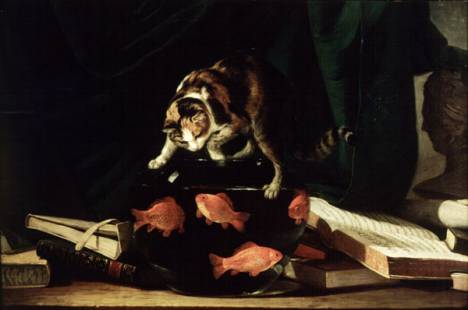
The "nymph" herself was Selima a tortoiseshell tabby cat owned by gothic novelist Horace Walpole (1717-1779) . The poor lady did indeed meet her untimely demise in a tub of goldfish at Walpole's house in Strawberry Hill, Twickenham. I must have seen the very same Chinese bowl (which Walpole had engraved with the first stanza of the poem) when I visited the house a few years ago. Wish I could remember it!

Walpole's friend, the poet Thomas Gray, was called upon to commemorate the tragic event in an epitaph. He wrote a poem instead. "I am about to immortalize [her] for one week or fortnight," wrote Gray to Walpole. We still feel the same mixture of pity and amusement two and a half centuries on!

What gives me greatest pleasure about the poem is the tone of it. There's such a contrast between the style of poem (a classical elegy which traditionally would have dealt with far loftier themes) and its content. There are plenty of classical allusions and references to Greek and Roman mythology. (A nymph is a water-spirit, genii are the spirits of the place, nereid are sea-nymphs.) Notice how the water in a fish bowl becomes a whole ocean? The gentle mockery is very funny.

Selima is spoken of in human terms. Her undoing is caused by her vanity (notice how she is entirely wrapped up in admiring her reflection in the second stanza) and her lust for gold ("What female heart can gold despise?/ What cat's averse to fish?"). Her death turned by Gray into a tongue-in-cheek moral lesson in the last stanza.

When I read the poem it reminds me of my own beautiful tortoiseshell tabby who flirts so outrageously with my husband I can't believe she's not trying to deliberately make me jealous! We're rivals, for sure. ("A fav'rite has no friends!")

Oh ... love also the form of the poem - the sixline stanzas with their aabccb rhyme scheme, and shorter third line. Formality here gives me much pleasure.

*Selima's portrait by Stephen Elmer (d. 1796). Note that the vase shown in the painting is made of glass - Elmer wanted to show his skill in painting fish!

Labels: , ,

Sunday, July 16, 2006

"The Eagle (A Fragment)"

Consider the majestic eagle, the 'nobility of the feathered society', soaring high among the clouds, searching — with eyes capable of spotting a rabbit from miles away or a fish beneath the water — and swooping to meet the ground to snatch its prey with his 'crooked hands'... and consider Lord Alfred Tennyson's brilliant poem:
The Eagle (A Fragment)

He clasps the crag with crooked hands;
Close to the sun in lonely lands,
Ring'd with the azure world, he stands.

The wrinkled sea beneath him crawls;
He watches from his mountain walls,
And like a thunderbolt he falls.

— Lord Alfred Tennyson, 1854
I used to spend long summer hours sitting on the steep slopes of the Plymouth Hoe, with its spectacular view across the Plymouth Sound, watching the surf and the sea-birds. This poem reminds me of those cliffs, the biting wind carrying the smell of the sea, and the harsh calls of the gulls. Conversely, whenever I see the sea I would be be reminded of Tennyson's description of the 'wrinkled sea' and remember this poem. So strong is the connection — that deliriously mutually-reinforcing association — between the sea, the Devonian coastline, and this poem in my mind that in my fanciful memories I would see on a clear day an eagle gliding high above the coastline and, through its eyes, see myself looking up — but I don't remember ever having seen an eagle in the wild.

This poem is short — almost abrupt — and while some may wonder if it is a part of a larger work (because Tennyson titled this poem The Eagle (A Fragment)), I sense that it is meant to be so short, for in a lifetime one could be so fortunate to glimpse an eagle in its natural element.

I have, however, never looked more closely at this poem before today. For Puisi-Poesy, for the first time, I am going to take the poem apart and delve its intricacies. It might get a bit dense but do come along with me and let's see what we'll find.

We'll start with the first line:
He clasps the crag with crooked hands;
The alliterative hard 'c' sounds in this line — clasps, crag, crooked — heckle for the listener's attention. The metaphor in this line is remarkable: 'crooked hands'. Why not 'feet'? — the eagle uses its talons to grab and carry away its prey, using its feet like how we would use our hands. Also, the use of the word 'clasp' evokes an image of a link in a chain, as in the clasp of a bracelet, and here it is literally an image of a mountain chain linked to the eagle. It makes the eagle seem larger than life.

We see that the first line is set in a regular iambic tetrameter, but the lines immediately following it, the second and third lines, both start with a trochee (a stressed syllable followed by a non-stressed one, e.g. TI-ger) i.e.:
He CLASPS the CRAG with CROOKed HANDS;
CLOSE to the SUN in LONEly LANDS,
RING'D with the AZure WORLD, he STANDS.
At the end of line 1, we would expect the next syllable to be an unstressed one but as we move to line 2, we encounter a stressed beat. The intuitive reaction is to speed through the next syllables to regain the rhythm. In line two, the phrase 'lonely lands' can be slowed down, dwelling on the l's, lengthening the beats to compensate for the compression earlier in the line — the line's rhythm is balanced; after the compression, the expansion.

In line 3, a caesura is used as a device to control the poem's rhythm. As with line 2, again we intuitively speed through the first part of the line (note also the contraction of the word ring'd). Then, the comma after 'azure world' — the caesura in question — prompts a short pause before we continue with 'he stands'. Again the rhythm of the line is balanced; after a compression, a pause for expansion.

Contrast the first stanza with the second one, which follows a rigid rhythm instead:
The WRINkled SEA beNEATH him CRAWLS;
He WATCHes FROM his MOUNTain WALLS,
And LIKE a THUNderBOLT he FALLS.
I have seen versions of this poem with a comma in the sixth line i.e. "And like a thunderbolt, he falls." Others leave it out. Perhaps it is a revised version, or maybe it is simply where people would intuitively pause and therefore they have inserted the comma. I would prefer to omit the comma, for I believe that Tennyson intended this stanza to be read continuously, building the momentum with the unwavering beats to flow unimpeded until we arrive at the final image of the eagle's fall.

Try reading the line out loud to sense the difference:
And like a thunderbolt [pause] he falls.
or
And like a thunderbolt he falls.
Which do you like better?

The poem is strongly end-rhymed, as you can see. It has an aaa bbb rhyme structure. No run-on lines... all are strongly end-stopped, giving a stately pace to the poem.

Because of its rhythmic qualities, as we have seen, and also for its sounds, it is a delightfully euphonious poem. I have noted the alliterative 'c'-words in the first line: 'claps', 'crag', 'crooked'; in the second line we have 'close', linking it to the first line; then: 'lonely' and 'lands', 'ring'd' and 'wrinkled', 'watches' and 'walls'.

Alliteration is the repetition of words with the same starting sound while assonance is the repetition of the vowel sounds. This poem exhibits a high level of assonance.

The first stanza is dominated with the sounds of the long-'a' in 'clasps', 'crag', 'hands', 'lands', 'azure' and 'stands'. The second stanza is peppered with the stressed-'a' sound in 'crawls', 'watches', 'walls', with near-rhymes in 'mountain' and 'thunder-'. Another obvious example of assonance in this poem are the 'ee' sounds in the fourth line: "The wrinkled sea beneath..."

Wooh! What a rigorous examination of just six lines of poetry! I hope nobody nodded off :-) I think that this poem was quite easy to analyze, and no wonder that it is a favourite of teachers to introduce the art of poetry. Last month Sham posted a richly musical poem called Sleep-stealer by Rabindranath Tagore. Have a look at it again, and try to spot the sound devices — alliteration and assonance — that I have shown, and see why it is such a fine poem.

What else to say about The Eagle? We haven't really explored the imagery used in the poem. Perhaps the personification of the eagle can be discussed. Do you think that there is an allusion to mythical role of the eagle as a messenger to the gods anywhere in the poem? Can you guess why, at the end of the poem, the eagle falls? [Find the answer here!]

Hope you all enjoyed this post. I certainly did enjoy writing it. Until next time...


Notes:

1. About Lord Alfred Tennyson:
We still look to the earlier masters for supreme excellence in particular directions: to Wordsworth for sublime philosophy, to Coleridge for ethereal magic, to Byron for passion, to Shelley for lyric intensity, to Keats for richness. Tennyson does not excel each of these in his own special field, but he is often nearer to the particular man in his particular mastery than anyone else can be said to be, and he has in addition his own special field of supremacy. What this is cannot be easily defined; it consists, perhaps, in the beauty of the atmosphere which Tennyson contrives to cast around his work, molding it in the blue mystery of twilight, in the opaline haze of sunset: this atmosphere, suffused over his poetry with inestimable skill and with a tact rarely at fault, produces an almost unfailing illusion or mirage of loveliness.

— Edmond Gosse, "Tennyson," in the 11th edition of the Encyclopedia Britannica.
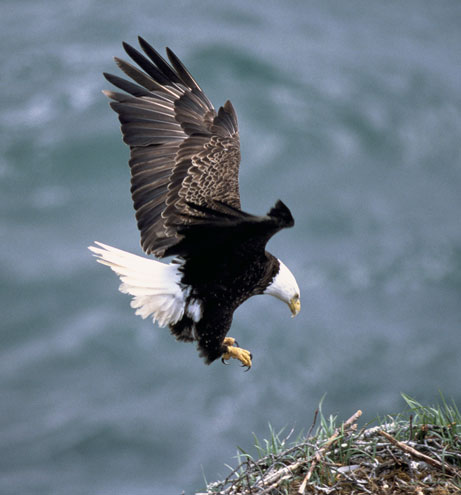
2. Picture of the American bald eagle from National Geographic.

Labels: , ,

Friday, June 16, 2006

"Bat"

At evening, sitting on this terrace,
When the sun from the west, beyond Pisa, beyond the mountains of Carrara
Departs, and the world is taken by surprise ...

When the tired flower of Florence is in gloom beneath the glowing
Brown hills surrounding ...

When under the arches of the Ponte Vecchio
A green light enters against stream, flush from the west,
Against the current of obscure Arno ...

Look up, and you see things flying
Between the day and the night;
Swallows with spools of dark thread sewing the shadows together.

A circle swoop, and a quick parabola under the bridge arches
Where light pushes through;
A sudden turning upon itself of a thing in the air.
A dip to the water.

And you think:
"The swallows are flying so late!"

Swallows?

Dark air-life looping
Yet missing the pure loop ...
A twitch, a twitter, an elastic shudder in flight
And serrated wings against the sky,
Like a glove, a black glove thrown up at the light,
And falling back.

Never swallows!
Bats!
The swallows are gone.

At a wavering instant the swallows gave way to bats
By the Ponte Vecchio ...
Changing guard.

Bats, and an uneasy creeping in one's scalp
As the bats swoop overhead!
Flying madly.

Pipistrello!
Black piper on an infinitesimal pipe.
Little lumps that fly in air and have voices indefinite, wildly vindictive;

Wings like bits of umbrella.

Bats!

Creatures that hang themselves up like an old rag, to sleep;
And disgustingly upside down.

Hanging upside down like rows of disgusting old rags
And grinning in their sleep.
Bats!

Not for me!
D.H. Lawrence

_________________________________________________________________________________

I've loved D.H. Lawrence's poetry since I also discovered him as a favourite novelist in my teens.

This poem seems to me a counterpart of another poem he wrote about animals, the much-better known Snake, which in would urge you to read if you haven't come across it before. (It's too good not to have in your head.) Both poems deal with prejudice and how it seems to be a culturally learned reaction running contrary to our instinctive selves.

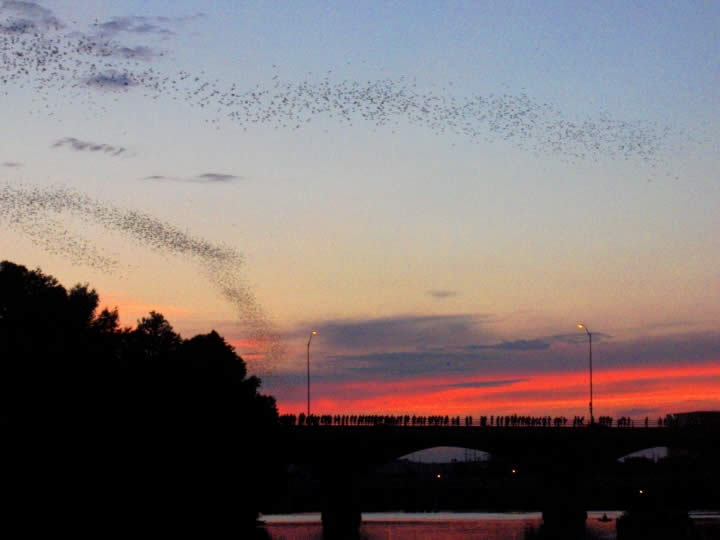
The words of this poem used to floods back into my head every time I take a late evening walk here. There's always that incredibly beautiful and peaceful moment when the sun dips behind the horizon, the call to prayers unwinds melodiously from the mosque ... and the swallows are suddenly replaced in the sky by bats. Take a stroll yourselves and see!

Lawrence's poem is set in Italy. The speaker realises that this "changing of the guard" has happened until some time after the bats have taken the place of swallows.

There's much to say about the poem, but I want to leave the fun of saying it to you!

Labels: , , ,