"Arrival"
Arrival
When I saw your father then. Before you birthed.__________________________________________________________________
I saw a boulder, broad chest, wavering
Awkward as his skin, stretched and cracked
Losing his old self.
I saw his words become weighed.
His life mission sharpening like a pencil.
I saw him testing father. He would roll it
Around like hot liquid and squint under its burn.
As you stretched in your mothers tummy,
So he stretched. He shed parts to prepare.
I saw a man naked and unsure, rolling daddy
Around his tongue, preparing like the raw trumpet
Stretching abstract notes creating jazz.
I saw you make him a man.
Malika Booker
 Malika Booker was in Malaysia last year both to perform and to run workshops, and I had the pleasure of interviewing her for StarMag, which is where this poem appeared.
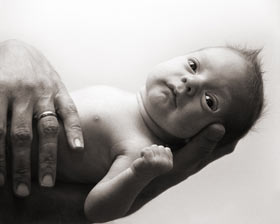
This is a very strong and moving poem about fatherhood, addressed by the mother to her child.
The main players in the act of childbirth are, of course, mother and child. But here in a sense the father too is being given birth to. It’s a highly effective shift of focus, especially as fathers often feel sidelined during the act of birth.
Look at how the new father’s initial awkwardness and hesitancy is highlighted, not just by the words, but also by the punctuation. The poem is choppy at first, the full stops occurring not at the end of grammatical sentences but between clauses in the first line. And how, in comparison, the long run-on sentence in the third stanza (with no commas in places where we would normally expect them) shows his growing confidence, his joy.
The imagery of the poem is extremely effective. The image of the skin stretching and cracking reminds the reader of a snake, shedding its skin, just as the man is sloughing off his old skin to find a new self within. I like too the way the image of the word ”father” being like hot liquid, a new taste sensation on the tongue, something that must be tested before it can be assimilated.
The father is described very effectively in the same terms as the baby – stretching, shedding parts (as the umbilical cord is shed, I suppose), naked. The reference to jazz improvisation is apt for there is no manual for fatherhood, and each man must come to it in their own way.
The poem reminded me of an earlier one I posted about learning the true meaning of becoming a father: The Almond Tree by John Stallworthy.
Give Malika’s poem to a new father near you!
(Written by bibliobibuli who is at the moment unable to move her blog over to Blogger 2).
Labels: poems about motherhood, poems about parenthood, Sharon's choices
posted by Leon Wing at 9:15 AM
|
4 comments


