Wednesday, May 16, 2007

"Words, Wide Night"

Somewhere on the other side of this wide night
and the distance between us. I am thinking of you.
The room is turning slowly away from the moon.

This is pleasurable. Or shall I cross that out and say

it is sad? In one of the tenses I singing
an impossible song of desire that you cannot hear.

La lala la. See? I close my eyes and imagine

the dark hills I would have to cross
to reach you. For I am in love with you and this


is what it is like or what it is like in words.


by Carol Ann Duffy (The Other Country)

_______________________________________________________________

This is a popular poem on the net – it comes up a lot when you google it and people post it on their blogs from missing other people in the dark of night, lying awake thinking of them. Needless to say I’ve probably done this a lot too!

I am a big fan of this poet – I like it that she is frank and truthful and pursues truth actively. I like it that her poetry is strong and unsentimental, clear but complex, and has a bite to it. I like it that her writing is about the journey, the process. I haven’t yet read her latest collection, Rapture, which won the TS Eliot prize recently.

The first line has a few inside rhymes, these are my favourite. First the “o” sounds, then the “ai” sounds:
Somewhere on the other side of this wide night

Then the alliteration: Somewhere on the other side of this wide night
Nice, huh? The ‘s’ consonent and ‘o’ sounds remind me of words of desire and longing. The ‘w’ consonant and ‘ai’ sound stretch out the spaces making everything feel unattainable.

The “ah” sounds in the second line sound like sleepy yawning and the “ih” sound like the REM of eyelids and thought spikes, then a half rhyme of ‘you’ and ‘moon’ making their connection “you are as available to me as the moon”:
and the distance between us. I am thinking of you.

The room is turning slowly away from the moon.
The last line of the first stanza has that inside rhyme again ‘room/moon’ maybe there’s a more technical term for it but I simply can’t remember anymore. Despite myself this line makes me imagine the room, a square white box in space slowly rotating away in a lonely manner towards empty black space, away from the grey, glowing, pitted surface of the moon. But I also know it means, these lovers anchored in their rooms in different locations, spinning away day after day, never getting any closer to the other. And I also think it is a play on the cliché that people who miss each other imagine the other looking at the moon too and missing them.

Phew, I think I’ll only do that for the first stanza. Let’s get on with the meaning of the next stanzas.
This is pleasurable. Or shall I cross that out and say
it is sad? In one of the tenses I singing
an impossible song of desire that you cannot hear.
I think this is an elegant way to say bitter sweet, it is pleasurable – a sensual word and it is sad, a true and simple word – nice juxtaposition. The next bit is the hardest for me to get a hold of: there’s a deliberate (I think – hope it is not a typo! Did check several versions online.) strange blip in the tense – like a word missing…in one of the tenses (past, present, future). The reader wants to substitute it – I am singing, I was singing, I will be singing…it is questioning where the lover fits into her life, like a daydream of possibilities we all have of our lovers.

By this time I am beginning to think it is not just physical distance but emotional distance which separates the lovers. (yes I am a bit slowww) – it is:
an impossible song of desire that you cannot hear.

La lala la.
Two people who should be together but aren’t create a (haha pun) ‘tense’ situation, an impossible song that not only is impossible physically to reach the ears of the lover – but also sounds like gibberish. She is almost saying, words are not enough and yet proving herself wrong:
See? I close my eyes and imagine
the dark hills I would have to cross
to reach you. For I am in love with you and this
is what it is like or what it is like in words.

I really identify with this, I used to try and imagine the journey between my lover and I, from one city round the world to another. Though ‘dark hills’ makes me think sex and intimacy, the secret psyche of another person we all want to know and connect with, in a lover.

I just love that last line in its simple statement which offers itself up with such vulnerability, somehow so irrevocable. The poem is an offering in itself. It is aware that it is a poem if you want to speak deconstructively! The lovely ‘w’ sounds are like spread hands offering up this person’s trust. If I were to offer someone words, it would be a very high compliment – so I take what she has said this way. She’s so unselfconscious. In her love poetry, I see the influence of Adrienne Rich, who is also gay, a pioneer in simple, beautiful (also physical and radical) expression of her love for her lovers.

Part of the reason why this poem is so well known, is that it was on the Circle Line on the Tube in London. That is where I saw it for the first time – and it led me to seek out and continue reading Carol Ann Duffy’s work. I met her at a Cheltenham Litfest reading and she signed this poem in my copy of the book.

(Guest blogged by Msiagirl)

Labels: , ,

Monday, March 26, 2007

"O Tell Me the Truth about Love"

I wanted to post Craig Raine's A Martian Sends a Postcard Home at first, having remembered that it was the first poem my literature teacher brought into class for Practical Criticism. A substantial part of the lesson was spent puzzling over idiosyncratic metaphors, characteristic of Martian poetry. But for now I urgently need to share this poem - the poem that kept me alive throughout my luckless Valentine's night.

O Tell Me The Truth About Love

Some say that love's a little boy,
And some say it's a bird,
Some say it makes the world go round,
And some say that's absurd,
And when I asked the man next-door,
Who looked as if he knew,
His wife got very cross indeed,
And said it wouldn't do.

Does it look like a pair of pajamas,
Or the ham in a temperance hotel?
Does it's odour remind one of llamas,
Or has it a comforting smell?
Is it prickly to touch as a hedge is,
Or soft as eiderdown fluff?
Is it sharp or quite smooth at the edges?
O tell me the truth about love.

Our history books refer to it
In cryptic little notes,
It's quite a common topic on
The Transatlantic boats;
I've found the subject mentioned in
Accounts of suicides,
And even seen it scribbled on
The backs of railway-guides.

Does it howl like a hungry Alsatian,
Or boom like a military band?
Could one give a first-rate imitation
On a saw or a Steinway Grand?
Is its singing at parties a riot?
Does it only like Classical stuff?
Will it stop when one wants to be quiet?
O tell me the truth about love.

I looked inside the summer-house;
it wasn't ever there:
I tried the Thames at Maidenhead,
And Brighton's bracing air.
I don't know what the blackbird sang,
Or what the tulip said;
But it wasn't in the chicken-run,
Or underneath the bed.

Can it pull extraordinary faces?
Is it usually sick on a swing?
Does it spend all it's time at the races,
Or fiddling with pieces of string?
Has it views of it's own about money?
Does it think Patriotism enough?
Are its stories vulgar but funny?
O tell me the truth about love.

When it comes, will it come without warning
Just as I'm picking my nose?
Will it knock on my door in the morning,
Or tread in the bus on my shoes?
Will it come like a change in the weather?
Will its greeting be courteous or rough?
Will it alter my life altogether?
O tell me the truth about love.

W.H. Auden

The thematic appeal of Auden's ballad derives from its irresistible lilt, its heady forward rhythmic rush, as if in love. (How it is consciously sought after in definition within the poem.) Like pub poetry, the language is simple and conversational. The speaker compares love to many things, particularising it ("soft as eiderdown fluff") and teasing out its character and characteristics, of which among many, is its ubiquitousness ("common topic on/the Transanlantic boats") due to an inherent mutability between objects ("pajamas" or "ham"?) and sometimes, into anthropomorphic entities ("knock on my door in the morning").

However, throughout the poem, love resists definition, plays hide-and-seek ("inside the summer-house/it wasn't even there") and at the end leaves the speaker's calls - in the form of insistent questions in alternating stanzas - unheeded, or at most, incomplete with the refrain
"O tell me the truth about love" crying out impatiently. The speaker's refusal or inability to settle for one precise definition (even when the penultimate line begs plainly for the first time: "Will it alter my life altogether?") speaks much about our human limitations of corralling love under a single pen, as so many poets writing on the subject of love do.

Still, the poem ships into our minds a catalogue of unforgettable images that ranges from the quotidian to the extraordinary, reminding us that when we are in love, love leeches in us like a vector; it hauls us to a greater, fresher signification of itself - just as the gentle undertow of the alternating metre and the cross rhymes could suggest constant revisions about love; such reflections on love, ultimately allows us
to pull through those blind sails, and see our lovers in a new light.

Before I protest too much, O tell me the truth about love.

P.S. Do check out other love poems by Auden, such as Lullaby...

Labels: , , ,

Wednesday, February 14, 2007

A Puisi-Poesy Valentine

Personally, Valentine's Day does not figure much in my calendar, but how could Puisi-Poesy let this day pass in silence? Being single and not having particularly romantic thoughts for anyone today I thought that I'd dedicate a post for our beloved poets and you the reader:
"À Une Passante"

The deafening road around me roared.
Tall, slim, in deep mourning, making majestic grief,
A woman passed, lifting and swinging
With a pompous gesture the ornamental hem of her garment,

Swift and noble, with statuesque limb.
As for me, I drank, twitching like an old roué,
From her eye, livid sky where the hurricane is born,
The softness that fascinates and the pleasure that kills,

A gleam... then night! O fleeting beauty,
Your glance has given me sudden rebirth,
Shall I see you again only in eternity?

Somewhere else, very far from here! Too late! Perhaps never!
For I do not know where you flee, nor you where I am going,
O you whom I would have loved, O you who knew it!

—
Charles Baudelaire in Fleurs du Mal, trans. Geoffrey Wagner.
(Psst: if you think French is la langue d'amour, listen here.)
Readers of cultural criticism may recall Walter Benjamin's writings on Charles Baudelaire's poems, how he describes a poet who is in perpetual state of shock when confronted with the metropolitan crowds of Paris, a poet whose response to the same anxieties that plagued William Wordsworth who tells us in this excerpt from his autobiographical The Prelude:
How oft, amid those overflowing streets,
Have I gone forward with the crowd, and said
Unto myself, "The face of every one
That passes by me is a mystery!"
Thus have I looked, nor ceased to look, oppressed
By thoughts of what and whither, when and how,
Until the shapes before my eyes became
A second-sight procession, such as glides
Over still mountains, or appears in dreams;
...was the exact opposite. "It is the phantom crowd of the words, the fragments, the beginnings of lines from which the poet, in the deserted streets, wrests the poetic booty," says Benjamin, describing the urban poet as a flâneur whose purpose is "to endow this crowd with a soul...[whose] encounters with it are the experience that he does not tire of telling about."

My reference to Wordsworth is only to provide the contrast to Baudelaire's poem, for where Wordsworth is baffled by "how men lived / Even next-door neighbours, as we say, yet still / Strangers, not knowing each the other's name.", Baudelaire himself seemed to be enraptured by the city, and on one occasion, as we see even the glance of anonymous woman passing by inspires awe—"The softness that fascinates and the pleasure that kills"—and delight, as if the he was reborn! Because yes! one glance is enough to affirm to the poet that he was also an individual and deserves love, just as he ecstatically proclaims his love for the unknown woman.

For isn't it the feeling of awe that should inspire poets? Awe in the face of an obliterating assault to the senses ("The deafening road around me roared", the hustle and bustle of a city) and to retrieve from it some semblance of memory, if only a fleeting glimpse. Recently, in the comments to "Flight", Sharanya describes her experience of being hyper-aware of everything she observes, and I concur that this must be so: a poet must find ecstasy of the moment and convey to the reader who "...throbbest life and pride and love the same as I", says Whitman.

And so to you, dear reader, poets offer the gift of words wrought of passion. Give a poem to a loved one today, or even to a stranger (here is Whitman's 'To You': "Stranger, if you passing meet me and desire to speak to me, why should you not speak to me? /And why should I not speak to you?") ... or, at least, if you're a singleton like me, be content and smile, for there may be someone there giving you a second glance as you pass by, feeling 'The Catch', whispering on the edges of language: Car j'ignore où tu fuis, tu ne sais où je vais, / Ô toi que j'eusse aimée, ô toi qui le savais!

Labels: , , ,

Tuesday, January 09, 2007

"The Catch"


The Catch
By Robin Robertson

The tick you hear
is the heart valve’s catch,
holding back the wrong
traffic of blood;

this click is the notch in a run
of iron, and love is a ratchet
that slides only one way
and cannot return.


This poem is collected in Swithering, the winner of the 2006 Forward Prize for Poetry.

The Catch starts with a little sound, and Robertson spins this out in two sentences, which essentially, really, are just one sentence, as there is a semi-colon linking the second one.

I enjoy the monosyllabic manner in which Robertson conveys the ticking of a “heart valve’s catch” with just a pair of fall-rise rhythm. He reverses and varies this rhythm in the third line – rise-fall-rise - after showing us where the ticking is coming from, in the second line, where the rushing of “is the” leads to, and stops at, the slow rendering of “the heart valve’s catch”, with a comma to make sure you pause a little longer here. The third line runs-on very strongly towards the rushing sound (“traffic”) of the start of the fourth and last line of the first stanza, and stops at “blood”, a very strong end-stopping with a semi-colon.

In the first line of the next and last stanza, “click” rhymes back to “tick”, as a link. All these mechanical imagery of gears and valves and iron and ratchet is softened a little in the penultimate line, after “that”, with liquid and long vowels, because all this is because of love. What a ratchet does, the last two lines expands on, everything moving only in one direction, not able to go back. These two lines also link back to the last two lines of the first stanza with their motif of flow and direction.

Do you feel as in The Catch when you fall in love?

Labels: ,

Tuesday, August 08, 2006

"You Bring Out The Mexican In Me"


"You Bring Out The Mexican In Me"
by Sandra Cisneros

You bring out the Mexican in me.
The hunkered thick dark spiral.
The core of a heart howl.
The bitter bile.
The tequila l�ágrimas on Saturday all
through next weekend Sunday.
You are the one I'd let go the other loves for,
surrender my one-woman house.
Allow you red wine in bed,
even with my vintage lace linens.
Maybe. Maybe.

For you.

You bring out the Dolores del Río in me.
The Mexican spitfire in me.
The raw navajas, glint and passion in me.
The raise Cain and dance with the rooster-footed devil in me.
The spangled sequin in me.
The eagle and serpent in me.
The mariachi trumpets of the blood in me.
The Aztec love of war in me.
The fierce obsidian of the tongue in me.
The berrinchuda, bien-cabrona in me.
The Pandora's curiosity in me.
The pre-Columbian death and destruction in me.
The rainforest disaster, nuclear threat in me.
The fear of fascists in me.
Yes, you do. Yes, you do.

You bring out the colonizer in me.
The holocaust of desire in me.
The Mexico City '85 earthquake in me.
The Popocatepetl/Ixtacc�huatl in me.
The tidal wave of recession in me.
The Agustí�n Lara hopeless romantic in me.
The barbacoa taquitos on Sunday in me.
The cover the mirrors with cloth in me.

Sweet twin. My wicked other,
I am the memory that circles your bed nights,
that tugs you taut as moon tugs ocean.
I claim you all mine,
arrogant as Manifest Destiny.
I want to rattle and rent you in two.
I want to defile you and raise hell.
I want to pull out the kitchen knives,
dull and sharp, and whisk the air with crosses.
Me sacas lo mexicana en mi,
like it or not, honey.

You bring out the Uled-Nayl in me.
The stand-back-white-bitch-in me.
The switchblade in the boot in me.
The Acapulco cliff diver in me.
The Flecha Roja mountain disaster in me.
The dengue fever in me.
The ¡Alarma! murderess in me.
I could kill in the name of you and think
it worth it. Brandish a fork and terrorize rivals,
female and male, who loiter and look at you,
languid in you light. Oh,

I am evil. I am the filth goddess Tlazolt�otl.
I am the swallower of sins.
The lust goddess without guilt.
The delicious debauchery. You bring out
the primordial exquisiteness in me.
The nasty obsession in me.
The corporal and venial sin in me.
The original transgression in me.

Red ocher. Yellow ocher. Indigo. Cochineal.
Pi��n. Copal. Sweetgrass. Myrrh.
All you saints, blessed and terrible,
Virgen de Guadalupe, diosa Coatlicue,
I invoke you.

Quiero ser tuya. Only yours. Only you.
Quiero amarte. Aarte. Amarrarte.
Love the way a Mexican woman loves. Let
me show you. Love the only way I know how.


---------------------------


This time around, I'm sharing a poem by one of my favourite writers. Cisneros is a Mexican-American feminist poet and author, and this is from her 1994 poetry collection, Loose Woman.

It's a steamy, sexy, sensuous love poem -- and you can almost hear a celebratory parade in the background (or maybe that's only because I'm listening to baila right now). You can hear Cisneros reading her poem here. I'm unable to open the link myself, but maybe you can.

The basic structure of "You Bring Out The Mexican In Me" is that it's a list poem, a long reel of place names on a map of the interior, if you will. From the grandiose -- tragedies, heroines, legends -- to the personal -- tequila tears and single womanhood -- a whole plethora of memories emerges. Her lover has teased all of this out of her. He has made it possible for her to reach these previously esoteric parts of herself. She is all things -- the pre-Columbian, the colonizer, the colonized, the immigrant, the second-generation Chicana. And with sass and with tenderness, this is her response. It's a grand, horns-blaring kind of poem, but under it all, even during its most audaciously in-your-face moments, is a pervasive sense of awe and quiet gratitude -- hers is the kind of lover who restores her soul, smoothes over the scarring of life between cultures, repairs the fractures of her past. He brings out the Mexican in her -- he brings out her deepest knowledge, and deepest secrets.

"You", she says. You. Thus it's intimate. Who is this lover? Who or what provokes Cisneros thus? Does s/he exist? Perhaps it doesn't matter -- she needs the Mexican in her, with all its roaring glory and its hideous grief.

I am immensely influenced by Cisneros' work because to me, she's one of the few writers I've encountered who are able to successfully juxtapose a supposedly exotic identity with the supposedly more profane language of her expression. She navigates this interface with such skill -- and more importantly by far -- such sincerity, which is why she can offer up the most succulent exoticism there is and never once seem contrived or pandering to Orientalist tastes. And I applaud Cisneros for avoiding the use of a glossary, that most tell-tale of "exotic" devices, as doing so speaks volumes about the nature of her craft. In the case of this poem, I personally also feel it's unnecessary, because the spirit of the work shines nonetheless.

And speaking of influences, I've read some "after" poems based on this one (e.g. "You Bring Out The Klang Valleyite In Me"). Here's a suggestion to anyone who wants to take it up: if you like this, why don't we write our own after poems modelled on its structure and its soul, and share them, perhaps at the Puisy-Poesy reading? A few examples I found on the web are here (by a performance poet called Bao Phi -- this one's amazing), here (scroll all the way down) and here (this one's by a 6th-grader!). On that note, I'd also like to open up the floor again on the subject of Puisi-Poesy readings (or, if that's too intimidating, gatherings)... what are your thoughts? Would be great to hear from non-contributors especially.

Labels: , , ,

Monday, April 24, 2006

"To his Coy Mistress"

Had we but world enough, and time,
This coyness, lady, were no crime.

We would sit down and think which way
To walk, and pass our long love's day;
Thou by the Indian Ganges' side
Shouldst rubies find; I by the tide
Of Humber would complain. I would
Love you ten years before the Flood;
And you should, if you please, refuse
Till the conversion of the Jews.
My vegetable love should grow
Vaster than empires, and more slow.
An hundred years should go to praise
Thine eyes, and on thy forehead gaze;
Two hundred to adore each breast,
But thirty thousand to the rest;
An age at least to every part,
And the last age should show your heart.
For, lady, you deserve this state,
Nor would I love at lower rate.

But at my back I always hear
Time's winged chariot hurrying near;
And yonder all before us lie
Deserts of vast eternity.
Thy beauty shall no more be found,
Nor, in thy marble vault, shall sound
My echoing song; then worms shall try
That long preserv'd virginity,
And your quaint honour turn to dust,
And into ashes all my lust.
The grave's a fine and private place,
But none I think do there embrace.

Now therefore, while the youthful hue
Sits on thy skin like morning dew,
And while thy willing soul transpires
At every pore with instant fires,
Now let us sport us while we may;
And now, like am'rous birds of prey,
Rather at once our time devour,
Than languish in his slow-chapp'd power.
Let us roll all our strength, and all
Our sweetness, up into one ball;
And tear our pleasures with rough strife
Thorough the iron gates of life.
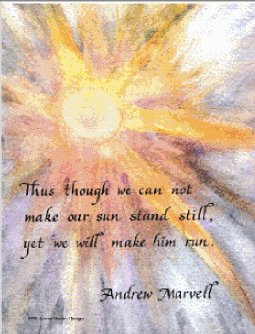
Thus, though we cannot make our sun
Stand still, yet we will make him run.

by Andrew Marvell

________________________________________________

Having commented on Dreamer Idiot's Wordsworth post the other day that I find contemporary poetry easier to relate to ... here I am dipping back in time to the C17th! This is probably a poem you already know well, and much anthologised.

But this is my favourite of all favourites! I can't remember when I first encountered it, but I can remember suddenly needing to read it and driving all the way to Bangsar to rummage through the poetry books in Skoob to find it. I learned it off by heart, as I do with all the poetry I love.

I used it in the classroom too. I loved putting it in front of my Matriculation classes when I was in teacher-training. Quite naughtily, I wouldn't explain a thing about it, just tell the students to get into groups and work out for themselves what the poet is trying to say ... and I enjoyed the look on their faces when they got the message! (I loved teaching poetry as a subversive activity!)

I remember the whole class laughing one time when a student suddenly exclaimed "He's just trying to get into her pants!"

But that's more or less it, isn't it? A three hundred year old poem ... and we know exactly what's going on.

There was of course much debate in the classroom about how genuine the guy is. Does he really adore his girlfriend this much, or is he just using every trick in the book to get his leg over, so to speak? (I hate to tell you but , although I firmly believe the former, my Malaysian students were way more cynical than me and ... could justify their interpretation in the light of personal experience.)

The poem is a monologue of sorts, addressing a lady who is playing hard to get. I love the way the speaker builds his argument in the three stanzas (Marvell was a politician so one must assume used to penning persuasive speeches!) by following the proposition: If we had, but we don't, so then ...
Yes, yes, you deserve to be loved like this ...
he says in the first, gently mocking his loved one even as he declares the extend of his love for her.

If we had enough time, he says, you could spend all day looking for rubies by the Ganges (which must have represented the height of exoticism at that time) while he would mooch around by the much duller Humber river (in the chilly North of England). Has his time scale for adoring her body parts. (Only 2,000 years for each breast in the face of eternity? I'd want them adoring for longer, I tell you!)

Then in the second stanza, he reminds her:
... but time's running out ...
We are bound by our mortality. Our lives are but a tiny speck compared with "the deserts of vast eternity".

The speaker switches tactic:
... ... so what are you keeping your virginity for? the grave and the worms? ...
My goodness, that image of the worms taking her virginity (especially after all the worshipping that's gone on before)! Clearly, he wants to shock his lady.

But, the argument is persuasive - common sense tells us that.

The pace of the poem quickens in the third stanza:
... okay then let's do it NOW! ...
becomes as breathless as lovers in the heat of passion. Did ever a line of poetry describe lust better than "while thy willing soul transpires/At every pore with instant fires"? I love the image "tear our pleasures with rough strife/Thorough the iron gates of life".

The poem ends with the magnificent cry of triumph "though we cannot make our sun/ Stand still, yet we will make him run."

The poem is a pleasure to read aloud. I love the richness of the imagery. But I love it most because it strikes me as very very true - life is so brief and we must grasp whatever experiences we can.

But - let me be naughty here for a moment - just as I like to imagine Dorothy Wordsworth giving her brother a hard time, I imagine the lady receiving this letter, giving it a quick glance over and scrawling this reply to be delivered by next post:
Whether I submit or nay,
The worms will get me, anyway.

Labels: , , ,